Associated Artists
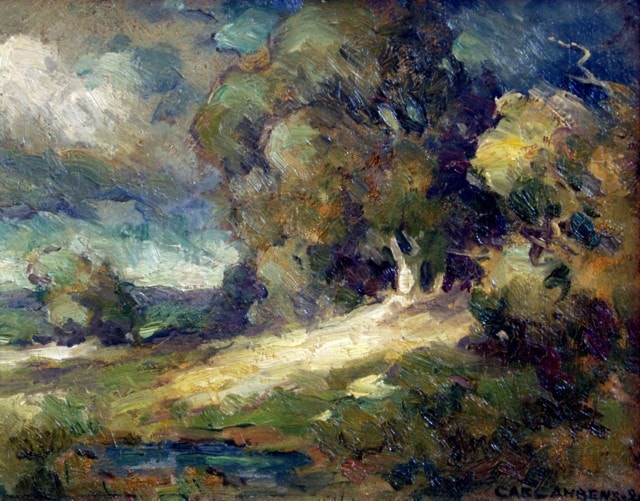
Carl Ahrens first made a name for himself in the Toronto art community of the 1890s, where he befriended noted painters Lucius O'Brien (1832–1899), John Wycliffe Lowes Forster (1850–1938), Frederic Marlett Bell-Smith (1846–1923), George A. Reid (1860–1947) and Wyly Grier (1862–1957). In 1894, his Toronto colleagues helped arrange for him to study under William Merritt Chase (1849–1916) in New York City.
While in New York, Ahrens met George Inness (1825–1894), an American tonalist painter, who became one of his most influential mentors. Inness encouraged Ahrens to leave New York, return to Canada, and paint what he wanted. Ahrens later resigned from all Toronto art societies to free himself from outside influences.
In 1900, he joined the Roycroft art colony in East Aurora, New York.
In his later years he had a rocky association with the painters who became the Group of Seven.

Homer Watson
1855–1936
Friend and fellow landscape painter
Homer Watson was one of Canada's most celebrated landscape painters and a close personal friend of Carl Ahrens. The two men shared a deep affinity for the Ontario countryside and a commitment to painting the Canadian landscape with honesty and feeling. Watson, who was based in Doon, Ontario, became internationally recognized after Queen Victoria purchased one of his paintings in 1880, earning him the nickname 'the Canadian Constable.'
Watson and Ahrens remained friends throughout their lives. A photograph taken at Alderside Park in New Dundee, Ontario in 1934 — just two years before both men died — shows them together in their final years. Watson died in May 1936, only months after Ahrens passed in February of that year.

Grant Macdonald
1909–1987
Friend and portrait artist
Grant Macdonald was a celebrated Canadian portrait artist and illustrator known for his elegant drawings of theatre and opera personalities. He was a close friend of Carl Ahrens in the later years of Ahrens's life. A photograph survives of the two men together, likely taken in the early 1930s.
Macdonald went on to become one of Canada's most distinguished portrait draughtsmen, producing thousands of drawings of notable figures in the arts. His friendship with Ahrens reflects the older painter's continued engagement with the Toronto arts community in his final decade.

Elbert Hubbard and the Roycrofters
1856–1915
Arts and Crafts community leader
Elbert Hubbard was the founder of the Roycroft Campus in East Aurora, New York — an Arts and Crafts community that attracted writers, craftspeople, and artists from across North America at the turn of the twentieth century. Carl Ahrens spent time at Roycroft around 1900, and a photograph from that period shows him there with other members of the community.
The Roycroft movement emphasized handcraft, beauty in everyday objects, and the dignity of skilled labour — values that resonated with Ahrens's own approach to painting. His time at East Aurora connected him with a broad network of American artists and intellectuals at a formative moment in his career.

Samuel Warner
1871–1947
Roycroft Art Director
Samuel Warner, a noted book designer, illustrator, painter and art instructor, was primarily known for his time as Art Director at Roycroft. Warner was the drawing instructor for one Martha Niles, whom he hired as an illuminator in the Roycroft Book Shop. Niles later became the second wife of Carl Ahrens.

Andre Lapine
1866–1952
Canadian painter of horses
Lapine was a Latvian-born Canadian painter known for his accurate depictions of horses, as well as for his landscapes and portraits. He met Ahrens in about 1911, and the two men became fast friends. Lapine was one of Ahrens' most ardent supporters through the 1910s and 20s, when it was not politically advantageous to do so in the Toronto art circles.
Portraits of Carl Ahrens by Other Artists


